For years, I’ve read about the many advantages of walking, and I’m sure you have, too. Among its plethora of benefits, it improves endurance, helps with hydration, burns calories, increases longevity, and reduces the risk of many chronic illnesses. It’s a great activity to continue into advanced age, or to incorporate into any work-out routine. And recently, I discovered it has some unusual perks that I want to share with you.
Strolling among waterfalls in Upstate New York
It helps our skin look younger. A study from Bispebjerg Hospital in Denmark found that exercise, including regular walking, stimulates collagen and elastin production and improves skin’s thickness. These benefits work together to make skin more wrinkle-resistant.
It helps curb our desire for sweets. From this Harvard Healthwrite-up: research confirms that walking can reduce cravings and intake of a variety of sugary snacks. A great reason to stroll after dinner!
It gets us out of worrisome thinking patterns. In his book In Praise of Walking: A New Scientific Exploration, renowned Dublin neuroscientist Shane O’Mara writes (walking) sets our thoughts free. Further, he says it is a holistic activity. Every aspect of it aids every aspect of one’s being, including our disposition.
It stokes the fires of creativity. Stanford Universityresearch shows that creativity improves while a person is walking and shortly thereafter. Maybe that’s the reason some of us pace when we’re trying to work out a problem.
It can become your daily meditation. For the first few minutes, take it slow and be mindful of every step, each pebble underfoot, and the presence of the sun’s warmth on your face. For more info on walking meditations, check out this link from UC Berkeley’s Greater Good Science Center.
Meditative walk on a beach in South Carolina
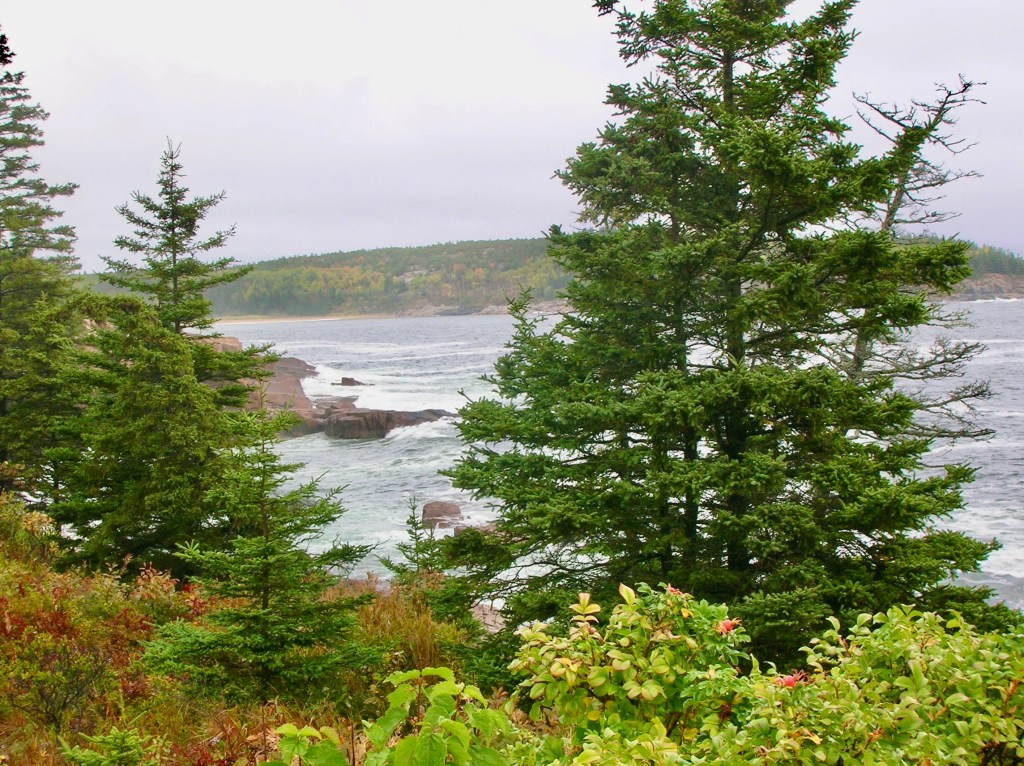
Of course, ambling alongside a creek, in a forest, canyon, or amongst wildflowers multiplies these benefits and adds many others. But you knew that already!
Now you have even more reasons to take that daily walk. The advantages above assist us in reaching greater potential. So what are you waiting for?!
View of the Atlantic Ocean & the South Florida coast at the end of a long pier walk
Blessings for Happy Strolls,
Lisa
On Thursday, September 15th, Marsha from Always Write and I are co-hosting a blogger meet-up at a restaurant in Mayer, Arizona, near Prescott Valley. If you can meet us for lunch (& lots of fun!) please RSVP to one of us. Hope to see you there!
The content of this article is for educational and informational purposes only, and is not intended as medical advice. Please consult with a qualified health care professional before acting on any information presented herein. Any statements about the possible health benefits of any subject discussed have not been evaluated by medical professionals or the Food & Drug Administration and are not intended to diagnose, treat, cure or prevent any disease or illness.
Over the past 2 1/2 years, our lives have changed dramatically. We’ve been subject to higher levels of stress & fear, experienced unprecedented loss, and spent more time at home. In this post, I shared that internet searches for weight loss info increased significantly just months after covid became prevalent, at the same time sales of comfort foods escalated. I think many of us have gained a few pounds since first learning of covid-19, and I am no exception.
She enjoys hunting from the windows.
As we get older, biological changes can make it more difficult for us to lose weight, as you may well know. That is a motivating factor for me to quickly eliminate my covid weight. And I want to share with you the steps I am taking, in case you’d like to make the journey with me. (These are in addition to caring for my gut’s microbiome, as detailed in my post Little-Known Weight Loss Strategies.)
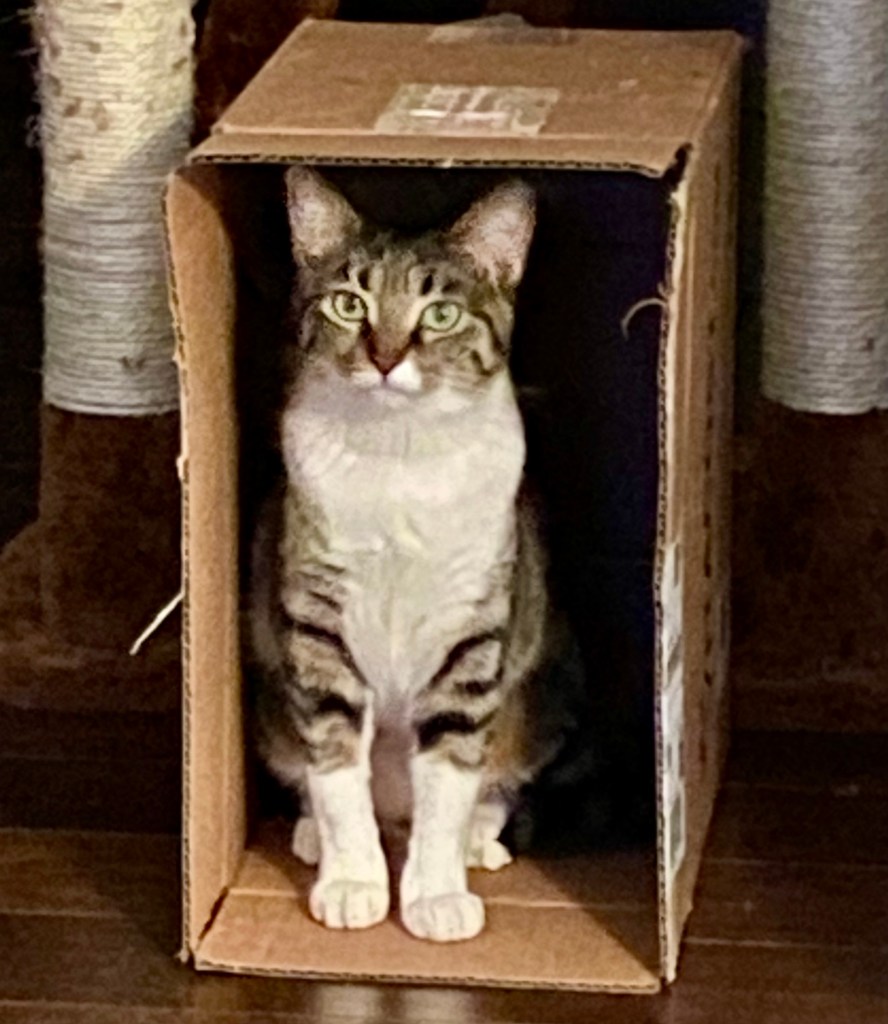
Izzy maintains her trim figure by being very active. (And she loves her box collection!)
I’m utilizing Ayurveda to a greater extent. (To learn some basics of Ayurveda, the world’s oldest healing tradition, check out this post.) Due to having a lot of Pitta (fire) in my constitution, I’ve started taking an Ayurvedic herb called amla & eating more bitter foods, both of which act to cool body heat and help with detoxification, a necessary component of weight loss due to toxins being stored in fat.
I am eating less at a slower pace. Chewing longer has become a focus. And when I first get the slightest indication I’m full, I stop eating. Hara hachi bu, a Confucian teaching meaning eat til you’re 80% full, is the principle I’m utilizing here. It’s a big change for me to be fully present while eating, because I’ve always eaten while doing other things.
I am eating all meals within a 7 – 8 hour window. Eating in this manner, i.e., between the hours of 10 am & 6 pm, gives ample time for proper digestion before I go to bed. This allows my energies to be directed to relaxation, brain drain, and other biological activities that are meant to occur during sleep. This window also works to allow for autophagy, a process whereby old, damaged, & diseased cells are destroyed, which serves not only weight loss but also overall health.
I am more active. In addition to my workout routine, I am cleaning closets, organizing cabinets, pulling weeds, trying new recipes, having more fun with my kitty, and being more social. Staying busy with these activities burns extra calories & helps me sit less. (As much as I love reading, watching documentaries, and spending time on my laptop, too much sedentary time can easily lead to weight gain and other unhappy consequences.) And according to data from Blue Zones, the longest-lived populations in the world, regular activity throughout our lives is a key to maintaining a leaner build.
I am getting more rest. Research shows that insufficient sleep triggers brain chemicals that induce hunger. In his book The Healer Within: Using Traditional Chinese Techniques to Release Your Body’s Own Medicine, Dr. Roger Jahnke shares a method that knocks me right out when I’m having a hard time falling asleep. A few short minutes spent massaging my ears, hands, & feet transports me to dreamland!
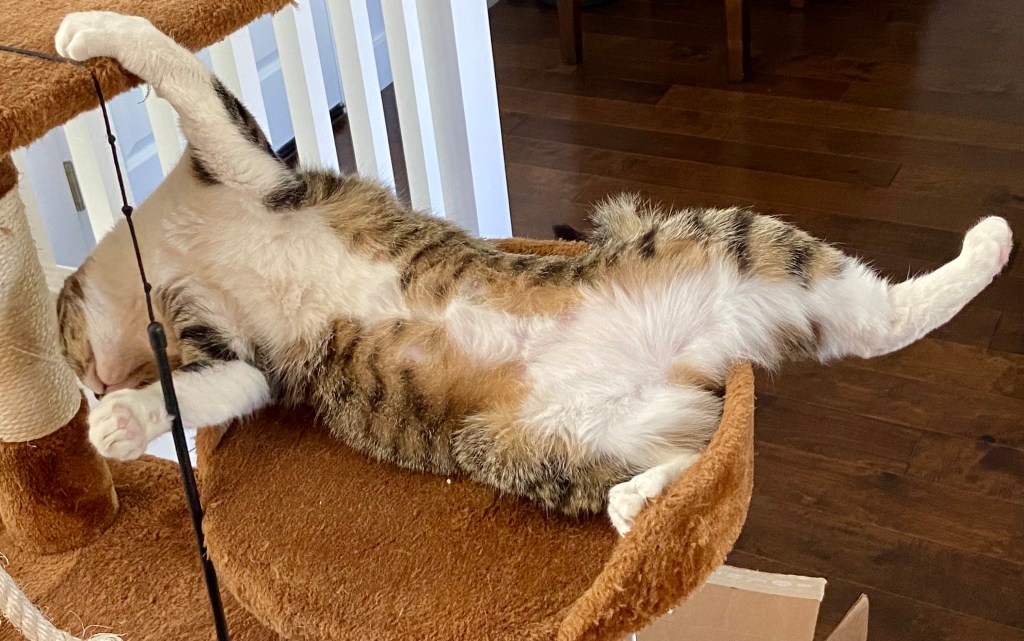
She does lots of cool yoga poses.
I am counting on these practices to boost my weight loss efforts. I hope they will work for you, too. May our collective future hold much less stress, fear, and restriction. And may we experience it without carrying those pesky covid pounds!
Blessings for Losing the Excess,
Lisa
On Thursday, September 15th, Marsha from Always Write and I are co-hosting a blogger meet-up at a restaurant in Mayer, Arizona, near Prescott Valley. If you can meet us for lunch (& lots of fun!) please RSVP to one of us. Hope to see you there!
She’s always worn out at the end of the day.
The content of this article is for educational and informational purposes only, and is not intended as medical advice. Please consult with a qualified health care professional before acting on any information presented herein. Any statements about the possible health benefits of any subject discussed have not been evaluated by medical professionals or the Food & Drug Administration and are not intended to diagnose, treat, cure or prevent any disease or illness.
Rain is falling steadily outside and has been for hours. The temperature has dropped about 15 degrees since it started and I’m certain there’s a touch of Fall in the air. It’s time for a simple but warm & filling pasta dish.
I came up with this formula years ago. The inspiration came from a recipe in an old cookbook that involved both boiling and sautéing vegetables. Because I’m always looking for ways to minimize cleanup, this delicious dish came into being.
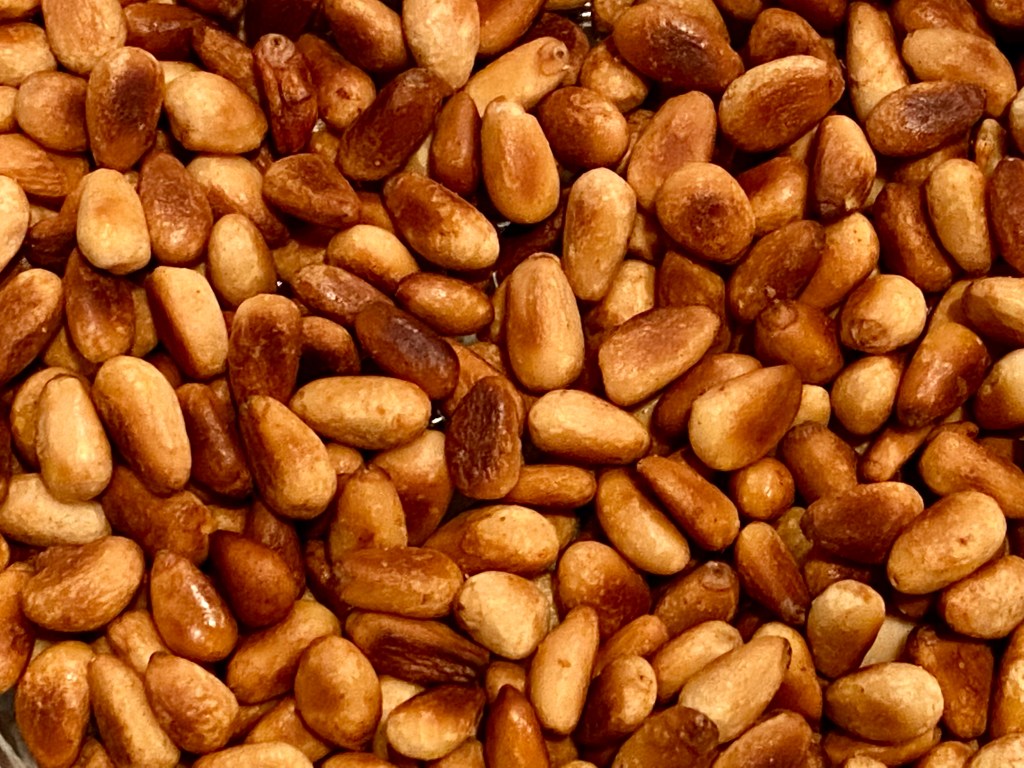
The pine nuts were a late addition to the recipe. I really like the crunch they contribute. Plus, they are rich in vitamin E, healthy fats, essential minerals, and B vitamins.
Broccoli is a cruciferous vegetable, and if you’re a regular reader, you’ll know I often touch on the advantages of the cabbage family. In last week’s post, I shared how they play a huge role in our anti-aging efforts. In my Glazed Autumn Bake recipe, I mentioned the fact that the more crucifers you eat, the more you benefit, whereas most veggies have a ceiling. And my post on Allergies reveals they contain quercetin, a pigment with anti-allergic functions.
The olive oil in this recipe is not heated, so its health-giving properties are higher than oil that is used to sauté. And the touch of crushed red pepper adds a pungent quality that stimulates circulation and really brings all the flavors together.
Enough talk, let’s get on with the recipe!
Yield: 3 – 4 servings
Ingredients (use organic or non-GMO whenever possible) 6 heaping tbsp almond meal 1 heaping tbsp nutritional yeast 1 tsp lemon zest 1/4 tsp Himalayan salt (or more to taste) ————————————————————- 1/4 cup pine nuts 10 oz pasta 2 medium potatoes, unpeeled, diced small 1 large head broccoli, cut into medium florets mineral salt to taste 1 – 2 tbsp good olive oil crushed red pepper to taste parmesan sub as desired (recipe below)
Directions Prepare the vegan parmesan by combining almond meal, nutritional yeast, lemon zest, & salt in a small bowl and mix well. Taste for salt, adding more if necessary.
Toast the pine nuts in your pasta pot over medium heat for just a few minutes, tossing with a wooden spoon, until most of them have a nice tan color. (Don’t walk away from them; they can go from having no tan to being burnt very quickly!) Set aside.
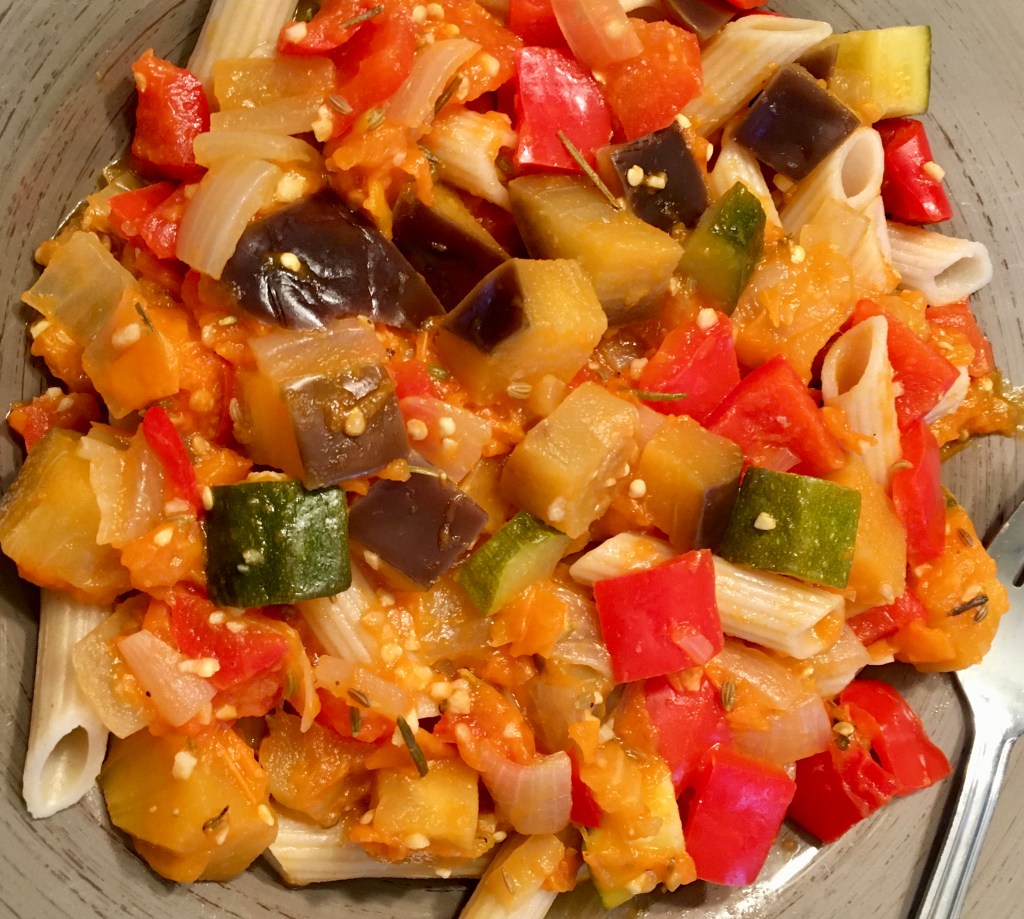
Carefully wipe out the pot (remembering it’s hot) and add a good amount of water – maybe 3 cups more than if you were cooking pasta only. Salt the water, cover the pot, & bring to a boil. Add the pasta, setting your timer a for few minutes longer than usual. (For example, my gluten-free pasta normally takes 12 minutes, so I set the timer for 15 minutes.) At about 2/3 of the way through cooking (so, at the 10-minute mark for my example), add the potatoes. Three minutes later, add the broccoli. Boil until the pasta & broccoli are al dente and the potatoes are just soft. Taste all 3 for salt, adding more to taste. Drain.
Divide the pasta and veggies between bowls. To each, add a drizzle of olive oil, a bit of crushed red pepper, and the parm sub to taste. Enjoy, both the meal and the light clean-up!
I won’t be around for comments this week, but I look forward to catching up with you next week! Have a great weekend! 😊
The content of this article is for educational and informational purposes only, and is not intended as medical advice. Please consult with a qualified health care professional before acting on any information presented herein. Any statements about the possible health benefits of any subject discussed have not been evaluated by medical professionals or the Food & Drug Administration and are not intended to diagnose, treat, cure or prevent any disease or illness.
Finally, the search is over: the fountain of youth has been discovered.
As much as some of us would like to, we cannot reduce our chronological age, the number of years we’ve been on the planet. But our biological age, also called our functional age, is determined by lifestyle and can be defined as theage your body acts, according to a Healthlinearticle. If you’re a 28-year-old who doesn’t exercise, eats high-fat foods, and has smoked for the last 10 years, it’s likely you have a biological age of greater than 28 years, the document explains. And the opposite is true as well: if you’re a 60 year old who stays active, physically and mentally, eats and drinks in a way that benefits your overall health, and gets plentiful rest, your biological age could be 40- or 50-something.
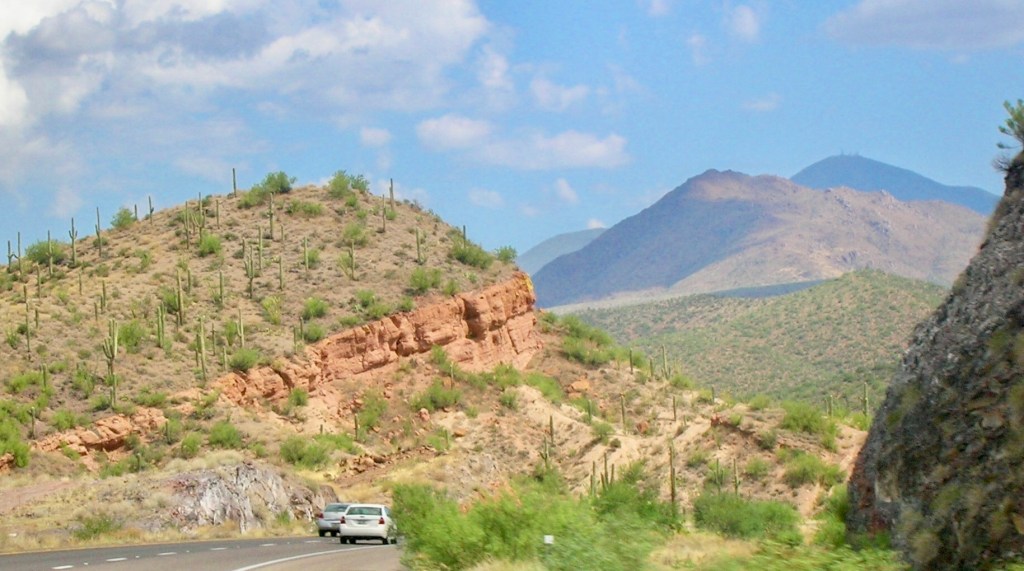
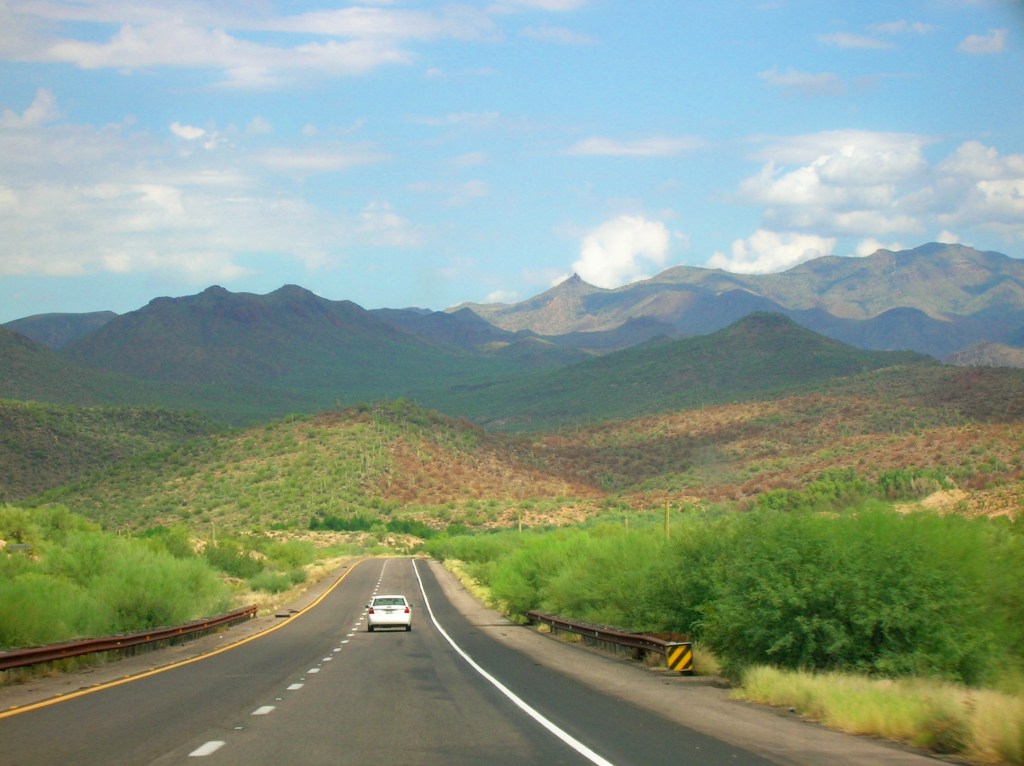
Arizona’s Mazatzal Mountains
A Pub Medresearch manuscript elucidates: Key hallmarks of biological aging have been defined by a feed forward loop, where cellular damage accumulation is progressive and ongoing over the lifespan. This gradual accumulation of damage results in alterations to molecular machinery and the eventual failure of cells to perform their functions. However, the aging biology mechanics are modifiable through lifestyle interventions.
Look closely & you’ll see a myriad of saguaro cacti
What are some of these lifestyle interventions? I’ll share 6 biggies.
Get adequate rest. You know how poorly a bad night’s sleep can cause you to feel. Research is accumulating on sleep’s effects on long term health & longevity. In fact, a National Institute of Healthpaper indicates sleeping 5 or fewer hours per night is consistently associated with increased risk for premature development and progression of age-related conditions (e.g., type 2 diabetes, coronary heart disease.)
Exercise regularly. This includes stretching for fascia support, cardio for maintaining a healthy heart & weight, strengthening to avoid muscle mass loss & help keep bones strong, and balancing for protection from falls. Becoming inactive, which many of us inadvertently do as we get older, can increase the aging process. (See my post Why Is Sitting the New Smoking? for more on that.)
Eat more broccoli. As well as Brussel sprouts, kale, cauliflower, cabbage, and other cruciferous veggies. They are rich in sulfur compounds that increase production of glutathione, a super-antioxidant that our bodies naturally produce less of as we age. This powerful free radical scavenger slows the aging process by assisting with immune function, cognitive ability, skin elasticity, and inflammation, this Frontline Alternativewrite-up sets forth.
Consume fewer processed foods and drinks. A Frontiers in Pharmacologyreport warns us that a diet with low amounts of fruits, vegetables, whole grains, seeds, and nuts, and an excess of foods such as ultra-processed grains and sugar-sweetened beverages is the leading contributor to chronic disease risk. And chronic diseases can result in daily pain and lethargy.
Take care of your brain. By taking on new challenges, whether traveling, doing puzzles, picking up a new hobby, or learning a foreign language, your brain continues to form new synapses. And make good hydration a priority; a study published in Frontiers in Aging Neuroscience established there is a direct link between chronic dehydration and the development of Alzheimer’s disease.
Spend time with friends & favorite family members. A US News & World Report article points out that the number of social interactions in a day improves life expectancy, even in people with heart disease and colon cancer. Sharing time with others can increase our tally of smiles and laughter, causing us to feel more vibrant.
Ok, so you may never be a youngster again chronologically speaking, but your body can act like one. It’s all a matter of tapping into the fountain of youth via healthy lifestyle choices. And I believe that’s a worthy endeavor, wouldn’t you agree?
Blessings for Reversed Aging,
Lisa
I won’t be around for comments the next couple weeks, but I look forward to catching up with you afterwards! 🌞
The content of this article is for educational and informational purposes only, and is not intended as medical advice. Please consult with a qualified health care professional before acting on any information presented herein. Any statements about the possible health benefits of any subject discussed have not been evaluated by medical professionals or the Food & Drug Administration and are not intended to diagnose, treat, cure or prevent any disease or illness.
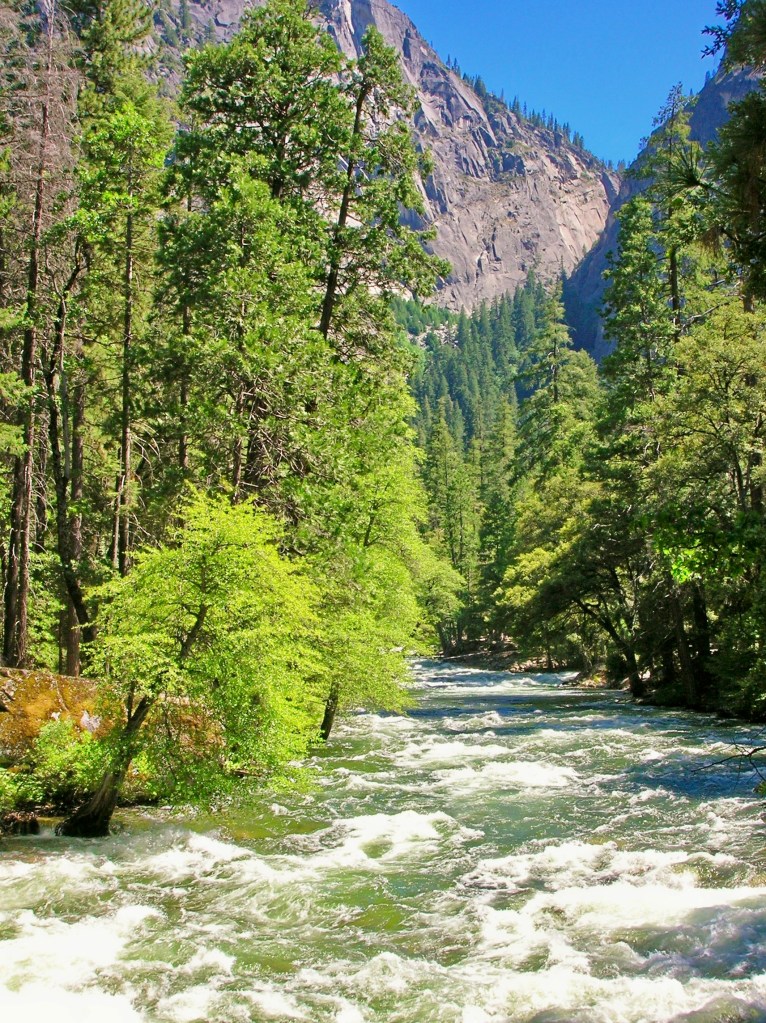
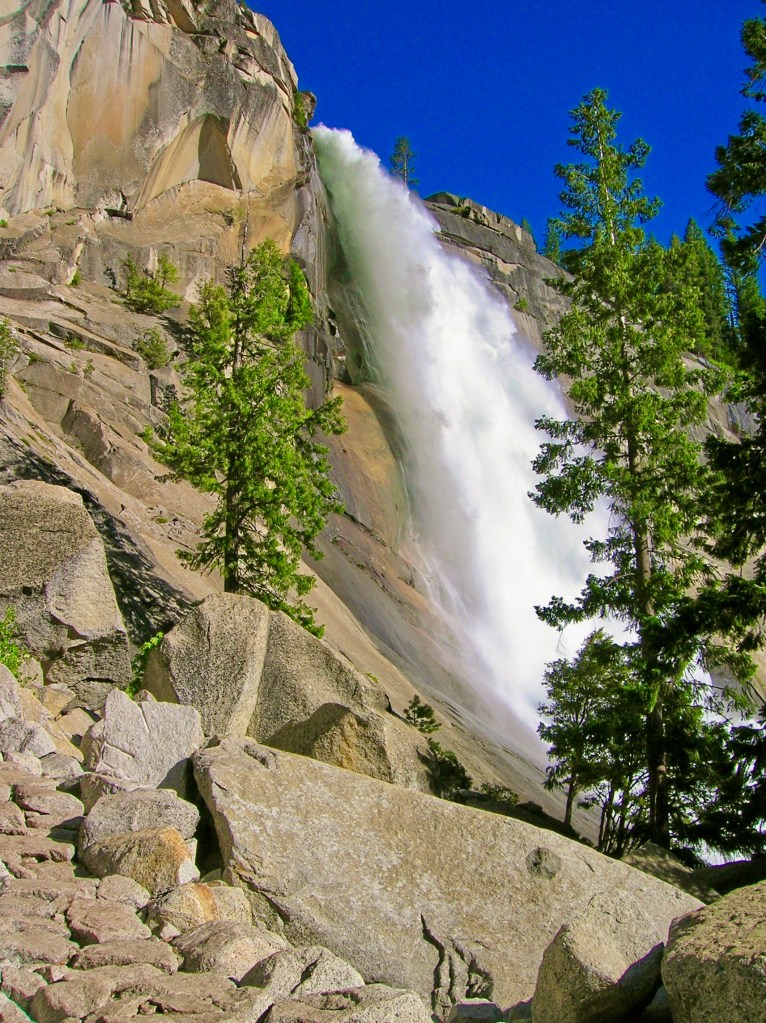
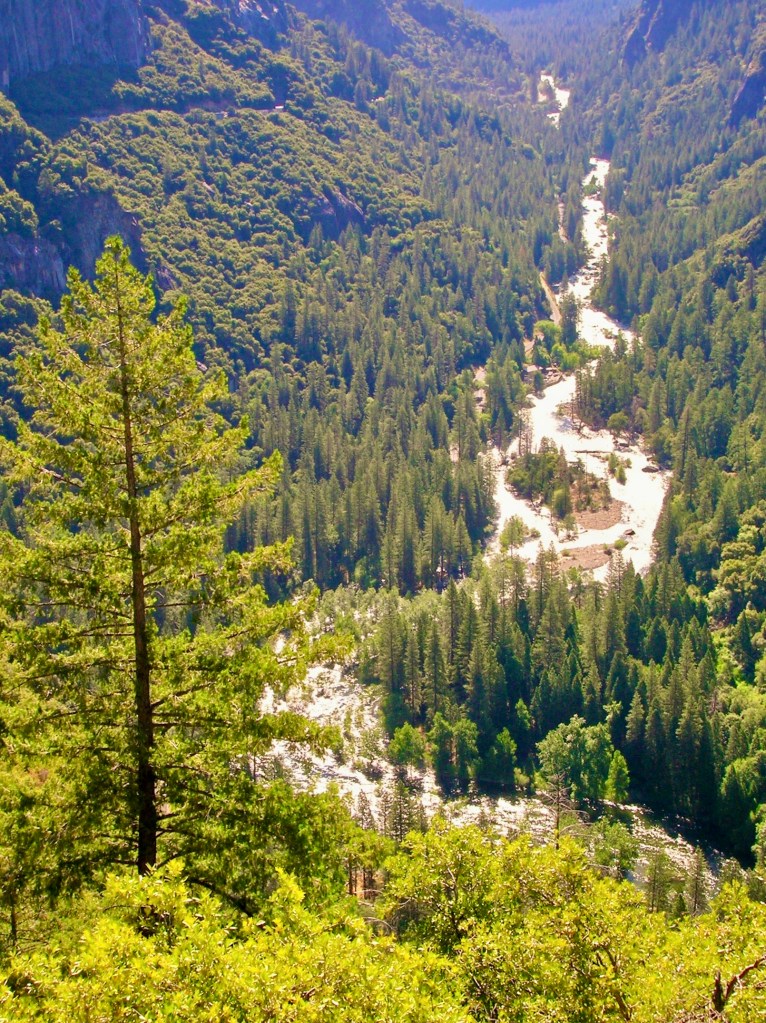
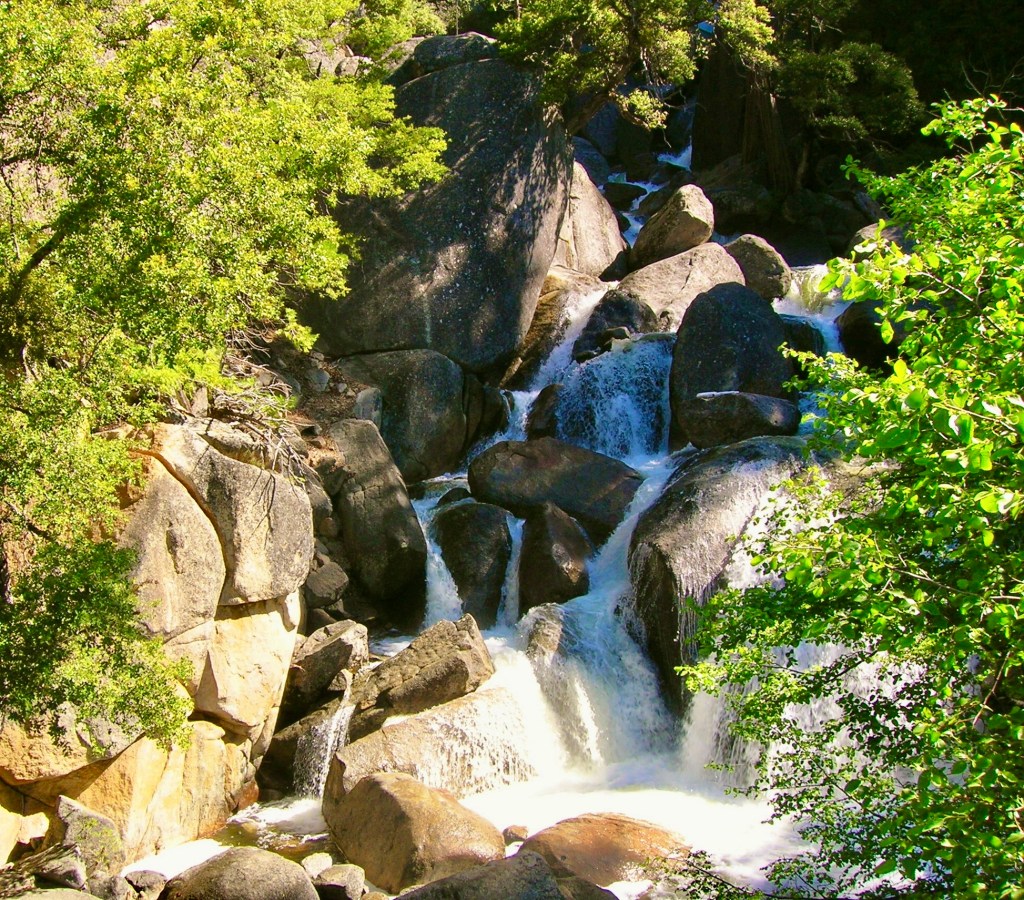
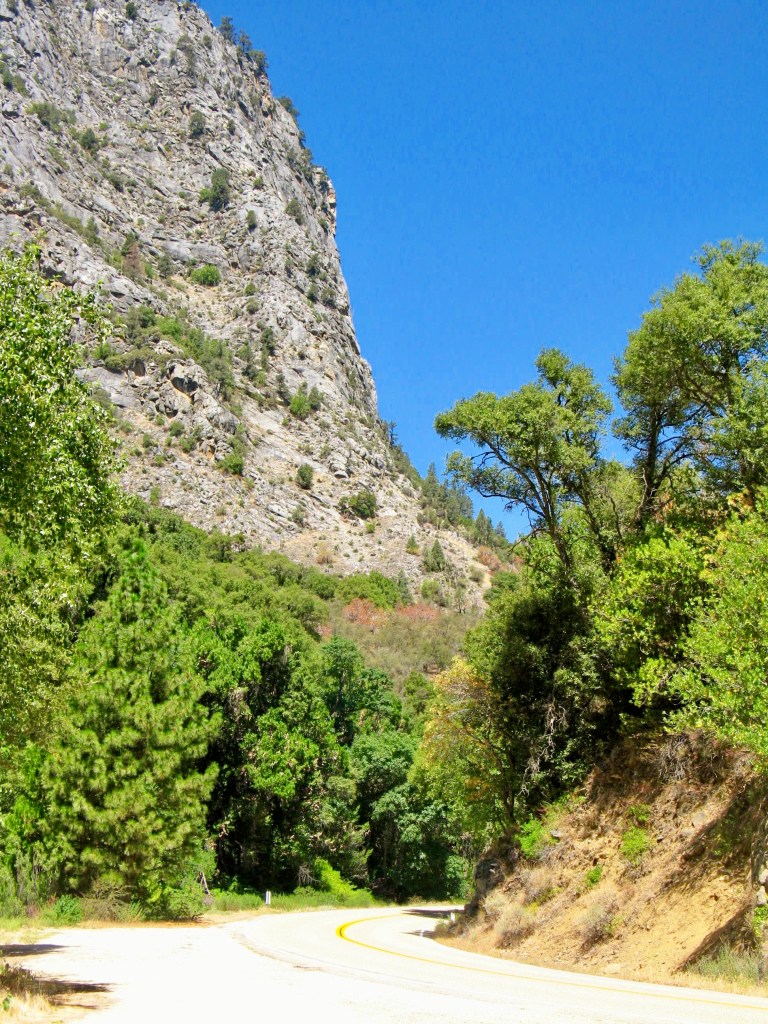
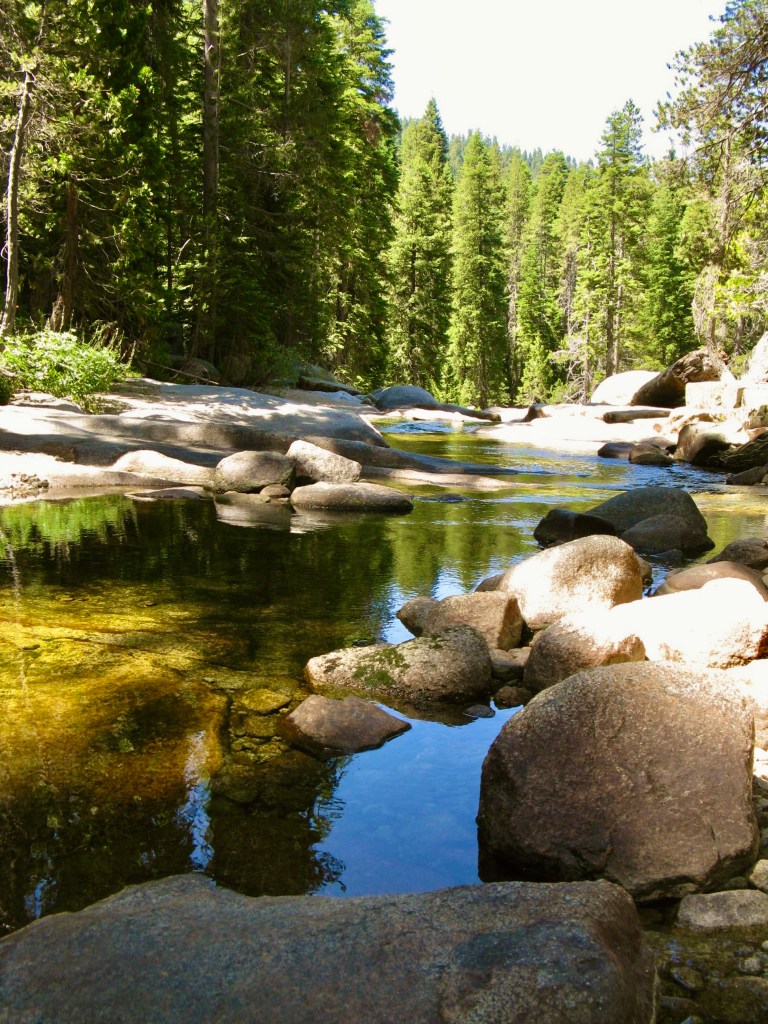
All photos were taken inside Yosemite National Park in California before devastating wildfires began frequenting the area.
Warning: this is not my typical post. It may be hard to read. It was certainly difficult to write. I don’t want to believe what I’m about to share. But I do. I must. We all must.
Global warming is changing us. We occasionally recognize it in the form of severe flooding, a killer heat wave, or a hurricane that is amongst the largest, strongest & most devastating we’ve seen. But we are quickly headed toward a time in which these and other climate-related catastrophes will be the norm. Because our civilization is doing so much harm so fast, the bits and pieces of news we receive about it are often outdated. And, as for the 2016 Paris Agreement’s goal of maintaining a global temperature of less than 2 degrees Celsius warmer than pre-industrial levels, we are already over 1 degree warmer. More damage has been done over the past 30 years than in all the rest of humanity’s history.
As human beings, we are vulnerable to confusing the unprecedented with the improbable. In our everyday experience, if something has never happened before, we are generally safe in assuming it is not going to happen in the future, but the exceptions can kill you. Climate change is one of those exceptions. ~Al Gore, Former US Vice-President & Environmentalist
David Wallace-Wells is a journalist who has written extensively on climate change for New York Magazine, The New York Times, The Guardian, and authored the book The Uninhabitable Earth: Life After Warming, published in 2019. To summarize some of the ideas in his book, if your primary concern is rising sea levels brought about by the melting of the polar ice caps, you should know that there are much more damaging effects in store. All that Arctic ice has kept who-knows-how-much carbon, the main driver of global warming, out of our atmosphere for thousands of years. It has also served to contain bygone diseases, keeping them dormant. Less ice means less reflection of the sun, contributing to even more heat. Increased temperatures can result in more frequent drought, full desertification of some areas, and decreased crop production. Fossil fuel particulate pollution will further contaminate our air & waters. Due to large swathes of land becoming uninhabitable from rising sea levels and sweltering heat, millions may be forced to migrate. And the likelihood these challenges will culminate in increased conflict, both locally and worldwide, is very good. What’s more, continued warming can make the whole of the earth inhospitable to humans, bringing us to extinction.
According to a recent policy paper from Australia’s Breakthrough – National Centre for Climate Restoration, there’s a good chance society could collapse as soon as 2050 if serious mitigation actions aren’t taken in the next decade (meaning prior to 2030.) Climate scientists are known to consistently underestimate the severity of what is actually happening, the paper warns.
In a short TED talk, David Wallace-Wells suggests paradigm-changing solutions. He explains science isn’t stopping us from taking action, and neither is technology. We have the tools we need today to begin. Of course, we also have the tools we need to end global poverty, epidemic disease, and the abuse of women as well. Which is why more than new tools, we need a new politics, a way of overcoming all those human obstacles — our culture, our economics, our status quo bias, our disinterest in taking seriously anything that really scares us. Our shortsightedness. Our sense of self-interest. And the selfishness of the world’s rich and powerful who have the least incentive to change anything.
Never doubt that a small group of thoughtful, committed citizens can change the world; indeed, it’s the only thing that ever has. ~Margaret Mead, Cultural Anthropologist
So, what can you and I do? First of all, we can stop hiding behind the idea that we’re helpless. Examine your choices around activities like eating, shopping, & vacationing, and make changes in ways, big & small, that will result in the wealthy elite benefiting less from your dollars. Don’t vote for political candidates who deny climate change or support environmentally unfriendly industries. If you must continue to eat meat, eat less of it, and buy only from companies that don’t utilize factory farms. Plant more trees, flowers, & shrubs, and grow your own food. Contribute your time or money to environmental causes. Learn & practice indigenous ways. Challenge your family to discover ways to live more sustainably. Strike up tough conversations about global warming with friends. Teach your children and grandchildren the importance of living in a manner that embraces all of life. Write letters to your congress person, or the editor of your newspaper or favorite newsletter. Blog about it. Bring it up on Facebook and Twitter. Share this write-up.
Anything else you’re interested in is not going to happen if you can’t breathe the air or drink the water. Don’t sit this one out. Do something. ~Carl Sagan
If you’ve read this entire post, congratulations and thank you. It’s difficult to read about things that make us uncomfortable. But the truth of these impending dangers can no longer be ignored, denied, or sugar-coated. Some of the negative effects of global warming are already upon us. Our individual lives and our society will suffer dramatically in upcoming years if we don’t begin to do things differently.
Blessings for Speedy Change,
Lisa
The content of this article is for educational and informational purposes only, and is not intended as medical advice. Please consult with a qualified health care professional before acting on any information presented herein. Any statements about the possible health benefits of any subject discussed have not been evaluated by medical professionals or the Food & Drug Administration and are not intended to diagnose, treat, cure or prevent any disease or illness.
I am saddened by the increase in wildfires ravaging our National Parks. These photos are from King’s Canyon in California’s Sierra Nevada.
If you are a tag reader like I am, you may have noticed all my posts include the word holistic. You may understand the concept, but my idea of it encompasses more than what’s normally considered. For that reason, I’d like to take the opportunity to explain.
First, I want to share a definition from the American Holistic Nurses Association:Holistic health is an approach to life where the whole person is valued. Rather than focusing on specific parts, holistic health considers the person’s body, thoughts, emotions, spirit and interaction with others and the environment.
All of our earliest healing traditions are holistic, including Ayurveda, Traditional Chinese Medicine, and Traditional European Medicine. Hippocrates, the father of modern medicine, asserted, It is more important to know what sort of person has a disease than to know what sort of disease a person has. Modern Western Medicine began as holistic, but now, the majority of its practices involve addressing particular issues with little regard for the whole person. This tendency to compartmentalize helps explain the long list of side effects often associated with surgeries and medications.
There are some holistic therapies practiced in the US. They include acupuncture, acupressure, reflexology, massage, cupping, chiropractic care, and aromatherapy. Even yoga and Tai Chi can be added to the list, making you your own practitioner. And meditation is a holistic therapy that can get you in touch with the very ground of your being.
The American-born theoretical physicist David Bohm referred to his body as a microcosm of the macrocosm. (Hmmmmm, where have I heard that phrase?) In his book Wholeness and the Implicate Order, he writes, We must learn to view everything as part of Undivided Wholeness in Flowing Movement. I really like that idea.
The idea of interdependence plays a starring role in this philosophy. (Read more on that in this post.) The health of everything in the human body, mind, and spirit is dependent on the condition of the whole. Our interactions with and the well being of our Primal Mother are a huge part of that. Some examples: we can become depressed with too little exposure to Nature. Our lungs can suffer from breathing toxic air. The liver can become stressed when our water is infused with chemicals. Our gut’s lining & microbiome can become dysfunctional as a result of eating foods that are grown from lab-modified seeds in nutrient-poor soils. And due to our body’s internal interdependence, these health issues affect other organs, our blood, nervous system, energy levels, and attitude.
Making strides toward a more holistic lifestyle is important for all of us, both individually and collectively. These are a few of my suggestions:
Ask for alternatives or adjuncts to medications or procedures. If your physician is not open to – or knowledgeable of – natural approaches, maybe look for a new one.
Choose organic, non-GMO, fair-trade, & sustainable foods. Entire forests are being destroyed for the purpose of producing the palm oil found in peanut butter and other foods. (Alliteration unintended.) Don’t buy it unless the label indicates it’s sustainably grown.
Avoid single-use plastics. If not recycled, which is common, plastic can stay in a landfill more than 100 years before decomposing. If you purchase bottled water, buy it in glass or 2.5 gallon containers. Better yet, take your own containers into a refill station each week. And when you shop, use your own bags.
Stay away from unethical investing. If you buy stocks, bonds, mutual funds, and the like, let your investment advisor (IA) know that you are interested only in ethical investments. For example, you don’t want to put money into companies that exploit poor populations by paying pennies a day for labor (more unintended alliteration) or “benefit” from environmental destruction. If your IA is ignorant of such practices (or claims to be) find one who is willing to make these concerns a priority.
In general, I believe living holistically boils down to this: practicing what best serves your life while also choosing to do the right thing for the whole. In your process of making daily decisions, keep in mind our undivided wholeness, upon which we are all dependent for long, healthy, happy lives.
Holistic Blessings,
Lisa
The content of this article is for educational and informational purposes only, and is not intended as medical advice. Please consult with a qualified health care professional before acting on any information presented herein. Any statements about the possible health benefits of any subject discussed have not been evaluated by medical professionals or the Food & Drug Administration and are not intended to diagnose, treat, cure or prevent any disease or illness.
All images display the imaginative work of wind and rain on sandstone inside Antelope Canyon
I’m just finishing the book Beauty: The Invisible Embrace, by John O’Donohue, who was an Irish poet, author, priest, philosopher, and environmental activist. His writings contain some of the most elegant, soul-stirring, thought-provoking prose I’ve read. It’s hard to believe I’m just now reading him for the first time.
The human soul is hungry for beauty; we seek it everywhere – in landscape, music, art, clothes, furniture, gardening, companionship, love, religion and in ourselves. When we experience the Beautiful, there is a sense of homecoming. We feel most alive in the presence of the Beautiful for it meets the needs of our soul. ~John O’Donohue
For me, this book is like none other. I struggled to get through the first few chapters because I kept thinking about what I was reading as I was reading it. That’s a lovely way to explain it. Ohhhh, what a beautiful line! Hmmmm, I’ve never thought of that . . . I would catch myself time after time, lost in thought with my eyes still moving across the page, with no clue of what I just read. It was a challenge to stick with the reading until I got to the end of a paragraph or a page. Ahh, the power of presence!
The imagination is always loyal to the deeper unity of everything. It has patience with contradiction because there it glimpses new possibilities. And the imagination is the great friend of possibility. ~John O’Donohue
I’m grateful I kept plugging away. I discovered a chapter entitled Imagination: Beauty’s Entrance, and I’ve read it several times over. I’d like to share a few of its points. (All quotes are from the book unless otherwise noted.)
The imagination awakens the wildness of the heart. This is not the vulgar intrusive wildness of social disruption. It is the wildness of human nature. Otherwise, he explains, convention could make our single adventure of life into a programme of patterned social expectation. According to Dr. Clarissa Pinkola Estés, Jungian analyst and author of Women Who Run with the Wolves, our wild nature is present at birth, providing us with passion, playfulness, inner knowing, creativity, courage, and confidence, but the process of domestication can result in this innate quality devolving into something that feels improper.
The imagination keeps the heart young. When the imagination is alive, the life remains youthful. Even near the end of life everything can come alive in new and unforeseen forms. This research from the Journal of Aging Studies explains that productivity, distinction, and anti-aging are major organizing principles for elders describing themselves as creatives.
The imagination has no patience with repetition. We become interested in what might be rather than what has always been. Experimentation, adventure, and innovation lure us toward new horizons. In Walking in this World: The Practical Art of Creativity, Julia Cameron writes, The soul thrives on adventure. Deprived of adventure, our optimism fails us. Adventure is a nutrient, not a frivolity. You might recall some of the reasons I am an adventure advocate from this post.
The imagination offers wholesomeness: heart and head, feeling and thought come into balance. An awakened imagination brings the warmth and tenderness of affection into the life of thought; and it brings clarity and light of thought to the flow of feelings. As Mark Twain wisely stated, You can’t depend on your judgment when your imagination is out of focus.
The imagination creates a pathway of reference for the visitations of beauty. It opens up diverse ways into the complex and lyrical forest of experience. To awaken the imagination is to retrieve, reclaim, and re-enter experience in fresh new ways. And in Kahlil Gibran’s masterpiece The Prophet, beauty is described as an ecstasy: a heart enflamed and a soul enchanted.
The brilliance of John O’Donohue’s writing caused me to pause and reconsider blessings I’ve taken for granted, like these jewels of the imagination. I encourage you to explore his work, as well, to bask in its powerful, heart-opening, sacred practicality.
When you regain a sense of your life as a journey of discovery, you return to rhythm with yourself. When you take the time to travel with reverence, a richer life unfolds before you. Moments of beauty begin to braid your days. ~John O’Donohue
Imaginative Blessings,
Lisa
The content of this article is for educational and informational purposes only, and is not intended as medical advice. Please consult with a qualified health care professional before acting on any information presented herein. Any statements about the possible health benefits of any subject discussed have not been evaluated by medical professionals or the Food & Drug Administration and are not intended to diagnose, treat, cure or prevent any disease or illness.
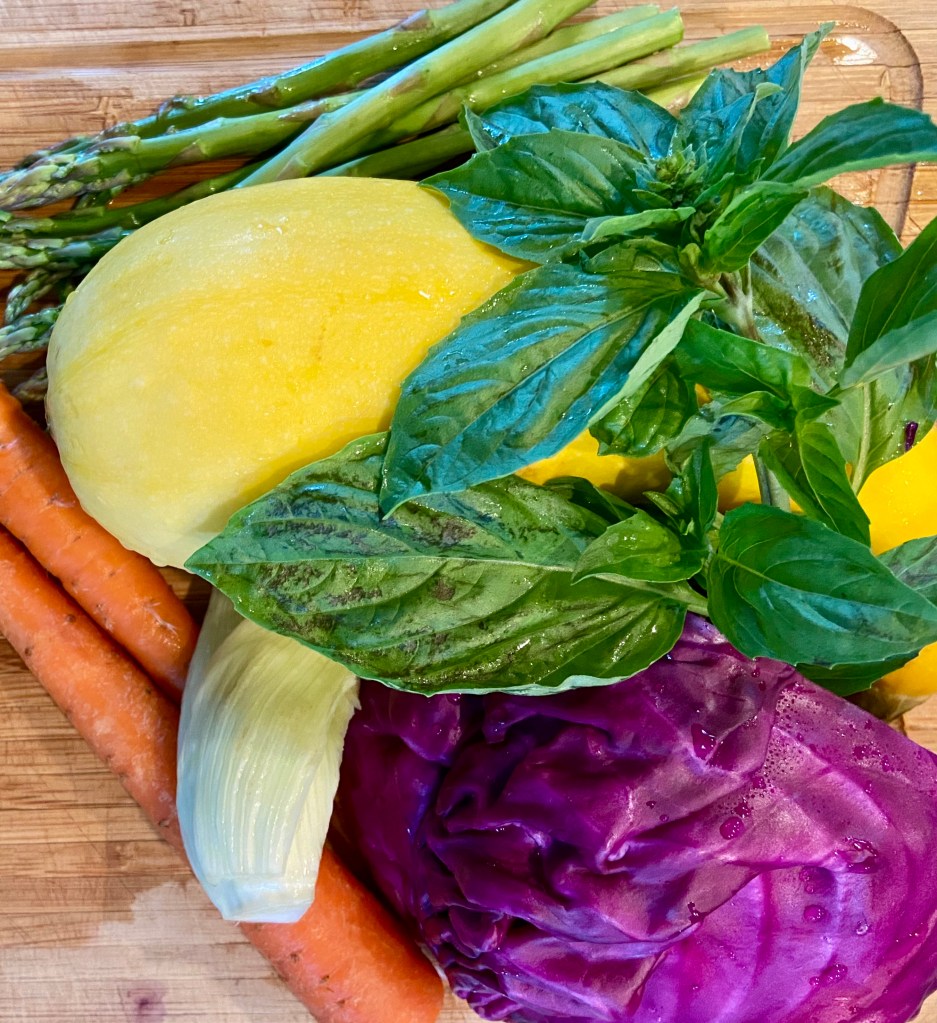
Summertime heat can be searing in Arizona, even in the mountains of the northern part of the state. Our intense sun makes me want to hike earlier in the day, have extra fluids at the ready at all times, and use the stove less! The idea for these super-simple wraps came about on one of our recent scorchers.
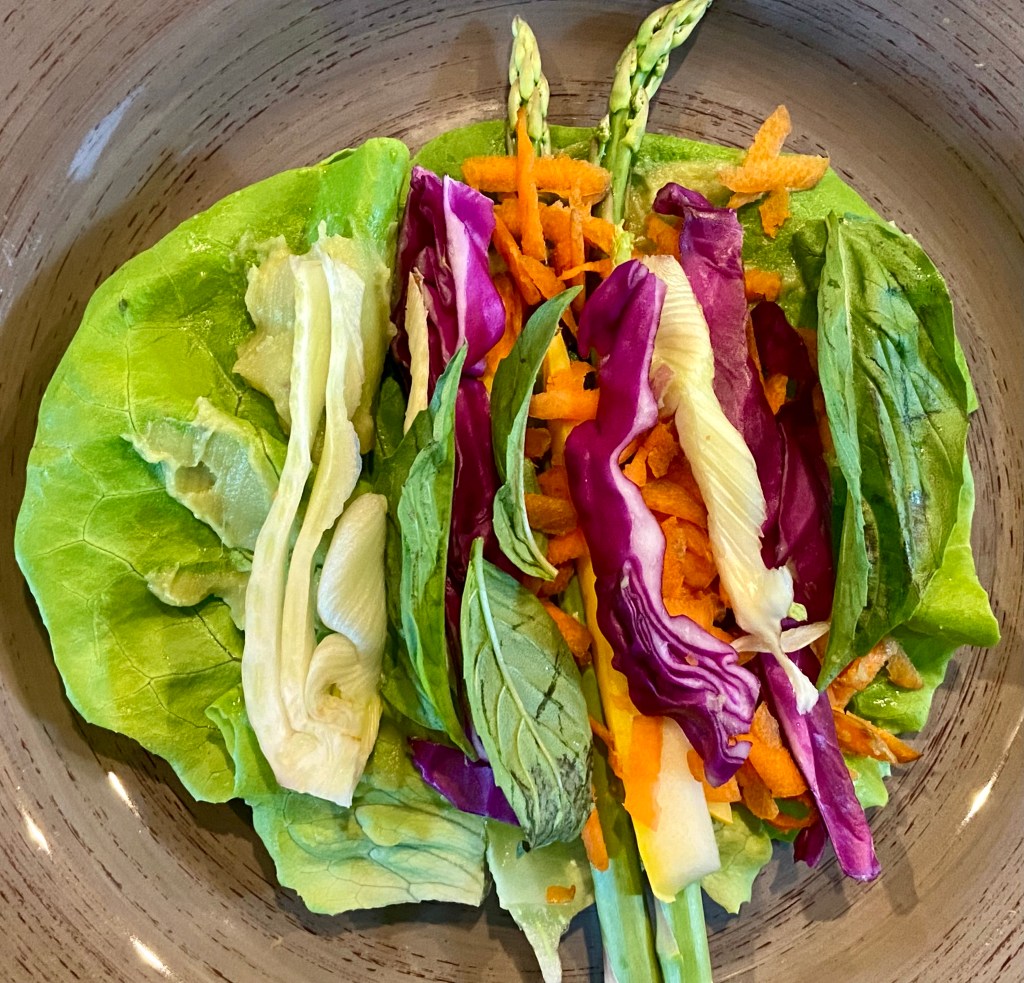
Owing to its combination of flavors and textures, this wrap is bursting with freshness. A couple of these tasty treats make for a nice lunch, picnic meal, or travel snack. They’d also be great to put in your backpack before hitting the trail.
The assortment of colorful veggies in these wraps provide many benefits of eating the rainbow. And raw veggies, as I explained in another summer recipe, are much more nutrient-dense, hydrating, and alkalizing than cooked. Plus, if you serve these wraps with berries and green tea, you have covered all of the 6 tastes, which should leave you feeling satiated for hours.
This recipe was inspired in part by this formula from Clean Eating Online.
Yield: 2 – 3 Servings
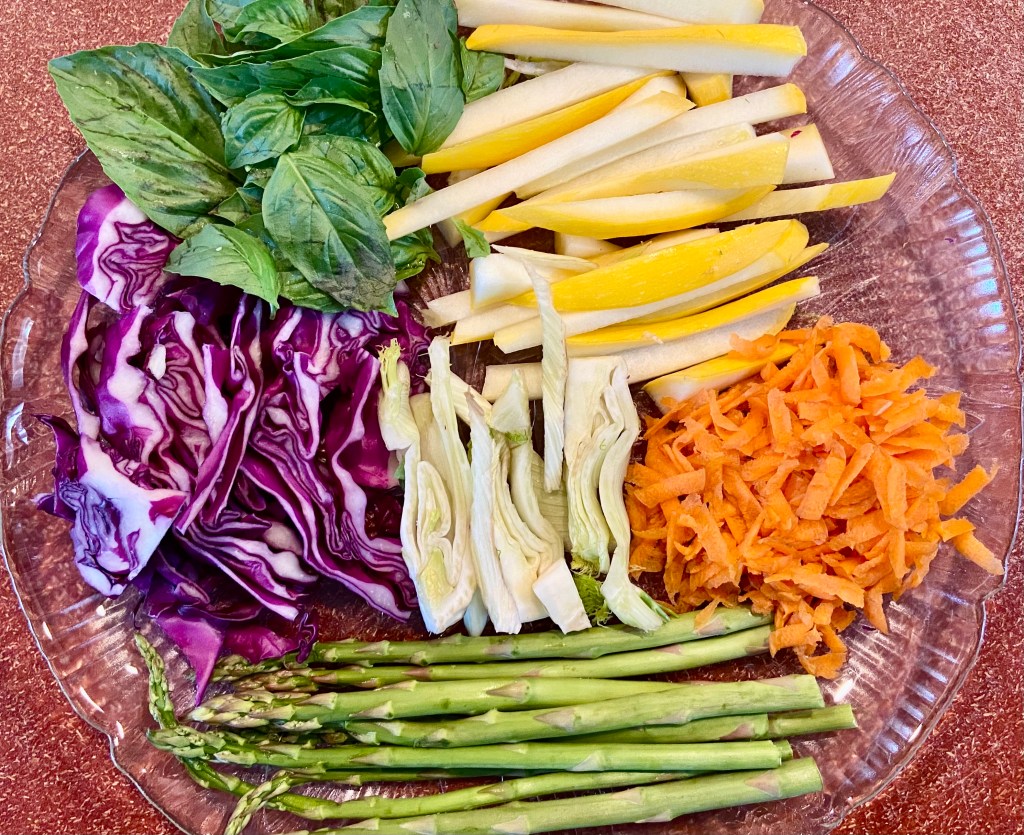
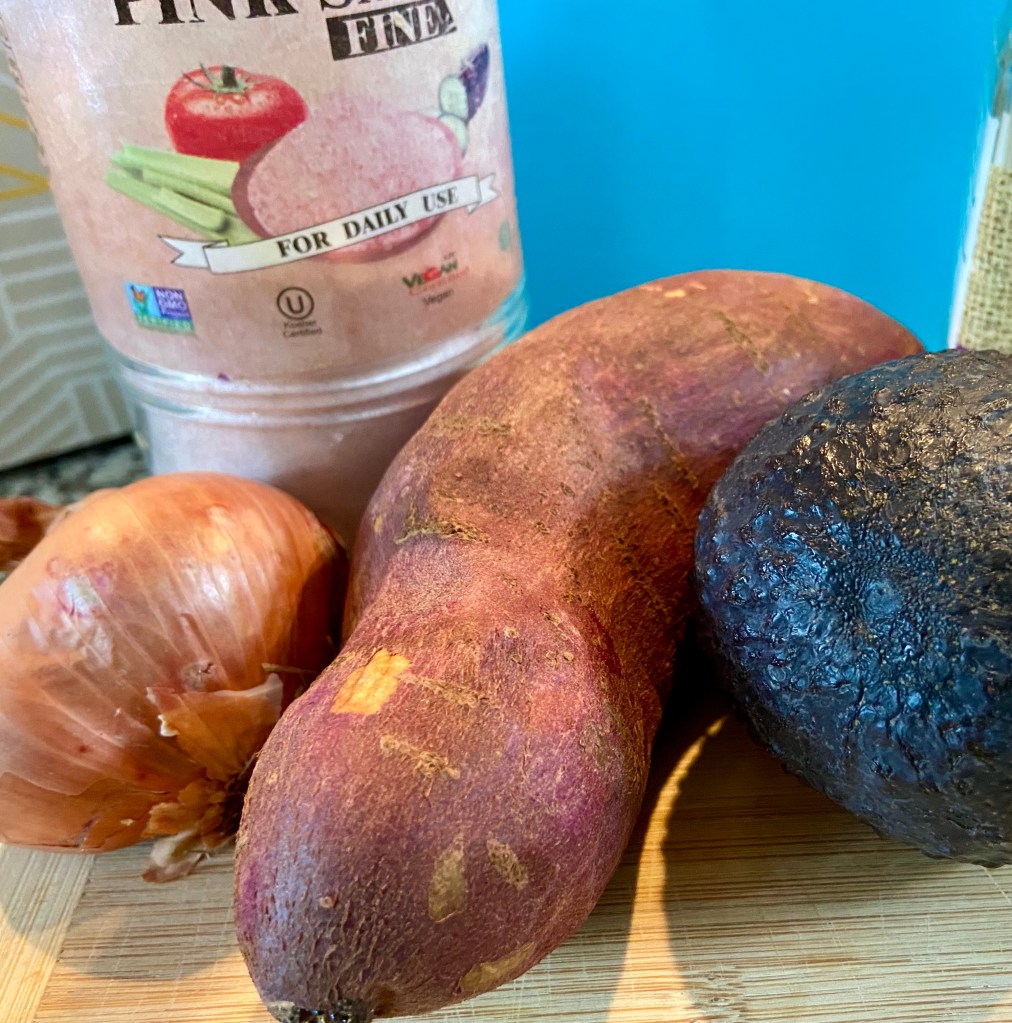
Ingredients (use organic or non-GMO whenever possible) 1/2 medium baked sweet potato 1/2 avocado 1 small shallot, chopped 1/4 tsp Himalayan salt, or to taste 4 – 6 butter lettuce leaves (or wraps of your choosing) 8 – 12 asparagus spears, trimmed 1/2 medium yellow squash, cut into thin strips 1/4 head red cabbage, sliced thin 1/4 bulb fennel, sliced thin 2 medium carrots, shredded 3 – 4 stems basil, leaves removed
Directions Spin the first 4 ingredients (1/2 of baked sweet potato through salt) in a small food processor until smooth. Taste the sauce for salt, adding more if necessary.
Slather the sauce onto one side of each butter lettuce leaf. Add a bit of all of the veggies, making sure not to skimp on the fennel or basil. Roll up & enjoy this healthy, delicious creation! (Wrap in wax paper for taking on picnics, road trips, hikes, etc.)
Before I started traveling extensively, I was showered with advice from friends and family. I received warnings like travel is dangerous, those people don’t like Americans, and you’ll be back home sooner than later. They all meant well, of course, but I’m not sure how many of them had done any traveling of their own, especially outside the country. In retrospect, I think they were giving me fear-based advice from what they had heard or assumed. Fact is, I’ve enjoyed all the places I’ve visited, and I’ve never felt ill at ease. Learning about new ways of life is fascinating to me. Exploring State and National Parks feeds my soul. Hiking and biking new country landscapes, towns, and villages puts a smile on my face that lasts all day. Seeing with my own eyes the ancient structures first glimpsed in the textbook of my college Renaissance Art and Architecture class thrills me. And the people I’ve met have been amicable, both the other travelers and the locals; they are always willing to direct me to the nearest cafe or train station, or help reorient me when I’m lost. My travel experiences have been nothing less than life-changing.
As a result, my advice is much different: I say you’re shortchanging yourself if you don’t travel! Of course, it’s never a bad idea to check for travel advisories, read guidebooks in advance, and be aware of your surroundings (which is true at home, as well.) But with good attention and preparation, the joy of travel can triumph over trepidation, even if you’re not part of a group. Below, you’ll find some of the reasons I feel travel can change our lives, individually and collectively.
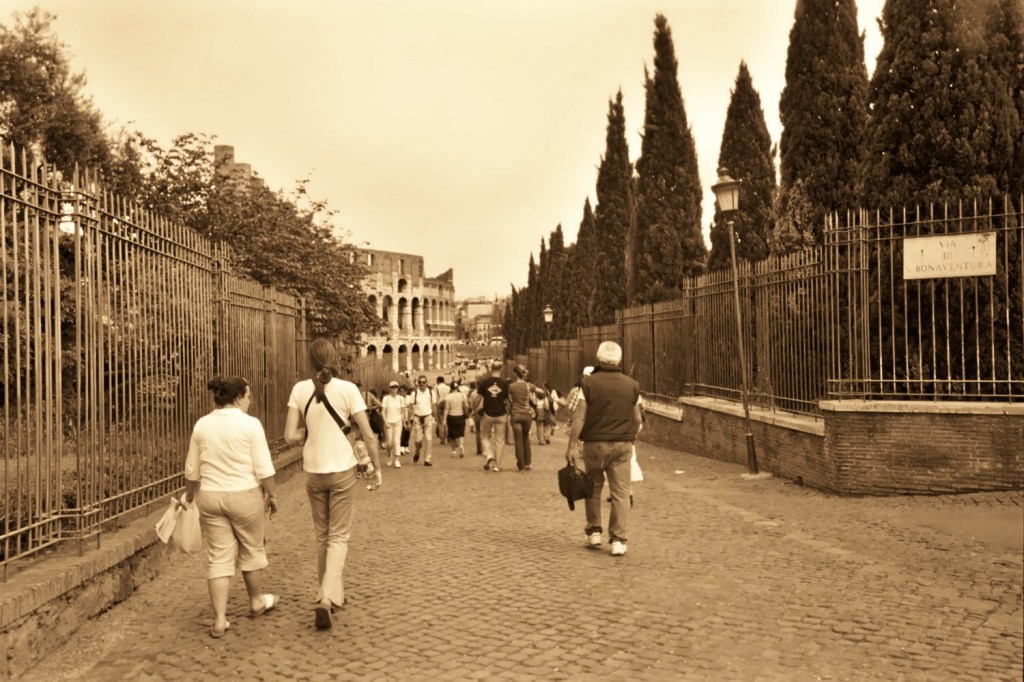
Walkway to the Colosseum in Rome
Experiencing new places and cultures allows you to get to know some of the populations you’ve heard about in the news, thereby reducing fear. Aversion toward groups of people that are different from us is often rooted in fear. Being in a distant land, whether in your country or another, you learn that most people are fundamentally like you: they love their families, go to work, take part in community, walk their dog, prepare meals, and treasure their beliefs. It’s truly an affirmation of life to witness the similarities.
Travel is fatal to prejudice, bigotry, andnarrow-mindedness. ~Mark Twain
Travel is one of the best educational experiences available. While experiencing new lands, you may learn about their history, politics, religion, art, language, food, flora, fauna, geography, topography, and much more. You may gain a new understanding of why things are as they are in that part of the world. Additionally, you might be challenged to plan your train or bus route, communicate with native speakers, find a restaurant, or locate a merchant who sells good wine and crusty bread for a picnic or locally sourced souvenirs for the folks back home. Being outside your daily norm can really augment your brain activity.
Trattoria tables in an alley, Rome
Travel will broaden your appreciation of Nature. This planet is amazingly diverse and beautiful. During your travels, you may come upon trees, flowers, or animals you’ve never seen. You might be delighted by tiny islands, waterfalls, snow-capped mountains, green seas, or volcanos. The awe you feel in their presence could prompt you to be a better environmentalist for the benefit of future generations.
The world is full of wonderful things you haven’t seen yet. Don’t ever give up on the chance of seeing them. ~J.K. Rowling
Gargoyle on Notre Dame Cathedral poised to gobble the Eiffel Tower (before the devastating fire)
Travel changes your perspective on life in general. With a broadened worldview, you’ll find your conversations will change. You may read or hear news stories with a different understanding. Your spending habits may shift, after realizing the value of experiences over objects. Your beliefs may even become less rigid and situations may appear less black or white.
Finally, the benefits of travel don’t stop giving. The memories, photographs, knowledge, new ideas, and increased cognitive abilities experienced can be with you for a lifetime. Perusing travel photographs and journals, regardless of their age, always brings joy to my heart and a big smile to my face.
View from the Seine, Paris
With all these amazing gifts that are yours for the taking, there is only one thing to do – make a plan to travel. Every chance you get. For a month, a week, or even a weekend. In your country or elsewhere. You’ll return with an enhanced sense of what it means to be fully alive. As Mark Twain said, Twenty years from now you will be more disappointed by the things you didn’t do than by the ones you did do. So throw off the bowlines, sail away from the safe harbor. Explore. Dream. Discover. My sentiments exactly!
Travel Blessings,
Lisa
The original version of this post, Six Reasons to Gift Yourself with Travel, was published in June of 2020, making it one of my first. Thank you, as always, for reading. And if you’ve been around since the first version, thank you again!
The content of this article is for educational and informational purposes only, and is not intended as medical advice. Please consult with a qualified health care professional before acting on any information presented herein. Any statements about the possible health benefits of any subject discussed have not been evaluated by medical professionals or the Food & Drug Administration and are not intended to diagnose, treat, cure or prevent any disease or illness.
Stress – it’s everywhere – in much of what we do, see, hear, and read. Most of us think of stress as an external circumstance that affects us in a detrimental manner. But we can have a lot of self-inflicted stress, as well, that can be just as harmful.
In a past post (Nature Interrupted), I addressed the idea of stressors that we don’t normally consider. These include matters that deprive our body’s cells of what they need for normal functioning: inactivity, too little time in Nature, being a night owl, poor eating habits, dehydration, and time in unsuitable environments, whether at work or home. And stress within a biological system, although it may go unrecognized, affects the entire human organism.
To reduce the stress you might be placing on your body, I’d like to offer a few suggestions. I realize making change is not easy, so I’d recommend trying one of these once or twice a week. In the words of the 70’s musician Robert Parker, A little bit of something is better than a whole lot of nothing.😊
Take yourself on an active Nature date. Research parks, trails, Nature preserves, and the like in your area and visit one to walk, run, cycle, do yoga, or practice Tai Chi. This idea is borrowed from Julia Cameron’s book The Artist’s Way, in which she proposes Artists Dates for sparking imagination and playfulness. When deciding where to go, Cameron writes, ask yourself ‘what sounds fun?’ You already know how much better you feel when you exercise; it makes your cells happy. And an article in Science Daily explains that even 5 minutes of outdoor exercise boosts mental health.
Go to bed earlier. Our biorhythms have been tied to earth cycles since humans first appeared on the planet. Burning the midnight oil is a modern expression often used as praise for one who works late into the night in the name of achievement. But getting your sleep and wake cycles more closely aligned with the movement of the sun can help you achieve cellular rejuvenation, preventing premature aging, disease, and early death. I’d say that’s more important, wouldn’t you? (For more on this idea, check out this post.)
Cook or make a healthy smoothie. On a regular basis, refrain from restaurants & processed foods to try a new, healthy, easy-to-prepare recipe. This not only loads your cells with nutrients & helps diversify your gut’s microbes, it also ensures your creations are infused with love. I have read that food preparation can be a spiritual practice, and your love & attention instills home preparations with benefits for the eater’s body, mind, & spirit. This is probably not the case at your local restaurant, and certainly not with food manufacturers.
Drink fruity water while soaking in a tub with Epsom salt. Slice up a lemon or lime and drop into a big glass of water for sipping as you soak your feet – or your entire body – in a bath with this magnesium compound. The citrus minerals and the magnesium in the bath contribute to deeply hydrating your cells. And since water is needed for each one of the billions of chemical reactions occurring in your body each second, this is an act of profound self-generosity.
Visualize a more positive life. If you’re not loving your job, home, the state of your health, or your relationship, take some time to visualize in great detail a better situation. An article in Psychology Today refers to visualization as a mental rehearsal used by such sports greats as Jack Nicklaus, Muhammad Ali, and Tiger Woods. Over the years, I’ve read about “miraculous” physical healings occurring using this method, as well. Seeing, even in our mind’s eye, is believing, and our biology responds accordingly.
Unlike much of the stress in our external world, we can control many of our internal biological stressors. Becoming mindful of the ways in which we can avoid inflicting harm on our personal organism can help our cells, and therefore our bodies, reach a higher level of being.
Blessings for Less Stress,
Lisa
The content of this article is for educational and informational purposes only, and is not intended as medical advice. Please consult with a qualified health care professional before acting on any information presented herein. Any statements about the possible health benefits of any subject discussed have not been evaluated by medical professionals or the Food & Drug Administration and are not intended to diagnose, treat, cure or prevent any disease or illness.